A bold headline
that delivers
Go ahead and say just a little more about what you do.
Call to action
Secondary


- Paginated grid that offered a more structured way to browse a wider
set of Rosenberger product families.

1
2
3
4
5

Rosenberger Toolbox
some descriptive text


My Certifications
My Team and I designed and developed a self-service Automotive Cable Configurator for our Client Rosenberger Group - to help their customers configure the exact cable assembly they need, without depending on a support team or a pre-made product page for every possible variation.
1. Project Overview
Rosenberger Customers didn’t just need automotive cables.They needed cable assemblies with the right connector type, channel setup, cable type, length, and end combination for their exact use case.
That means Rosenberger couldn’t realistically create pre-made product pages for every possible combination.
- THE CHALLENGE
Picture this:
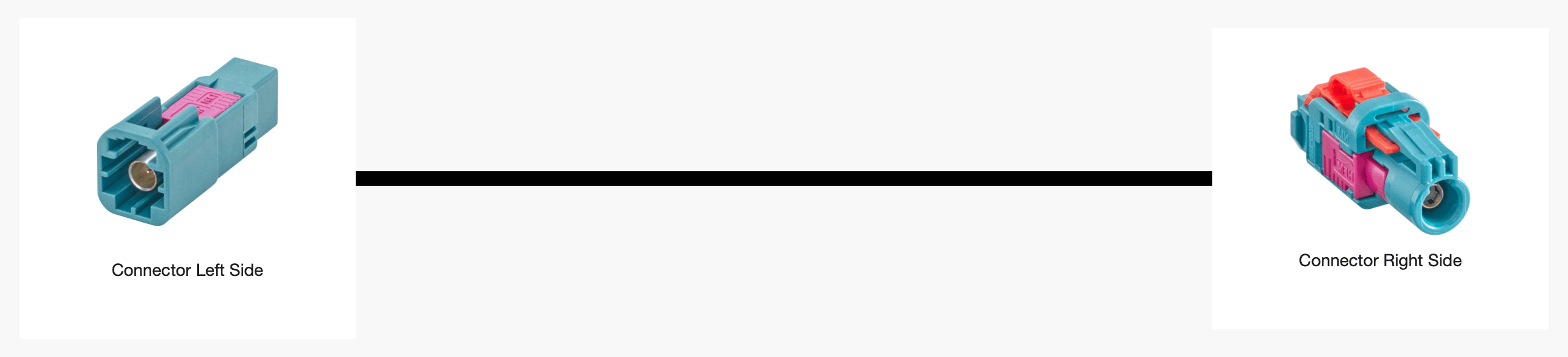
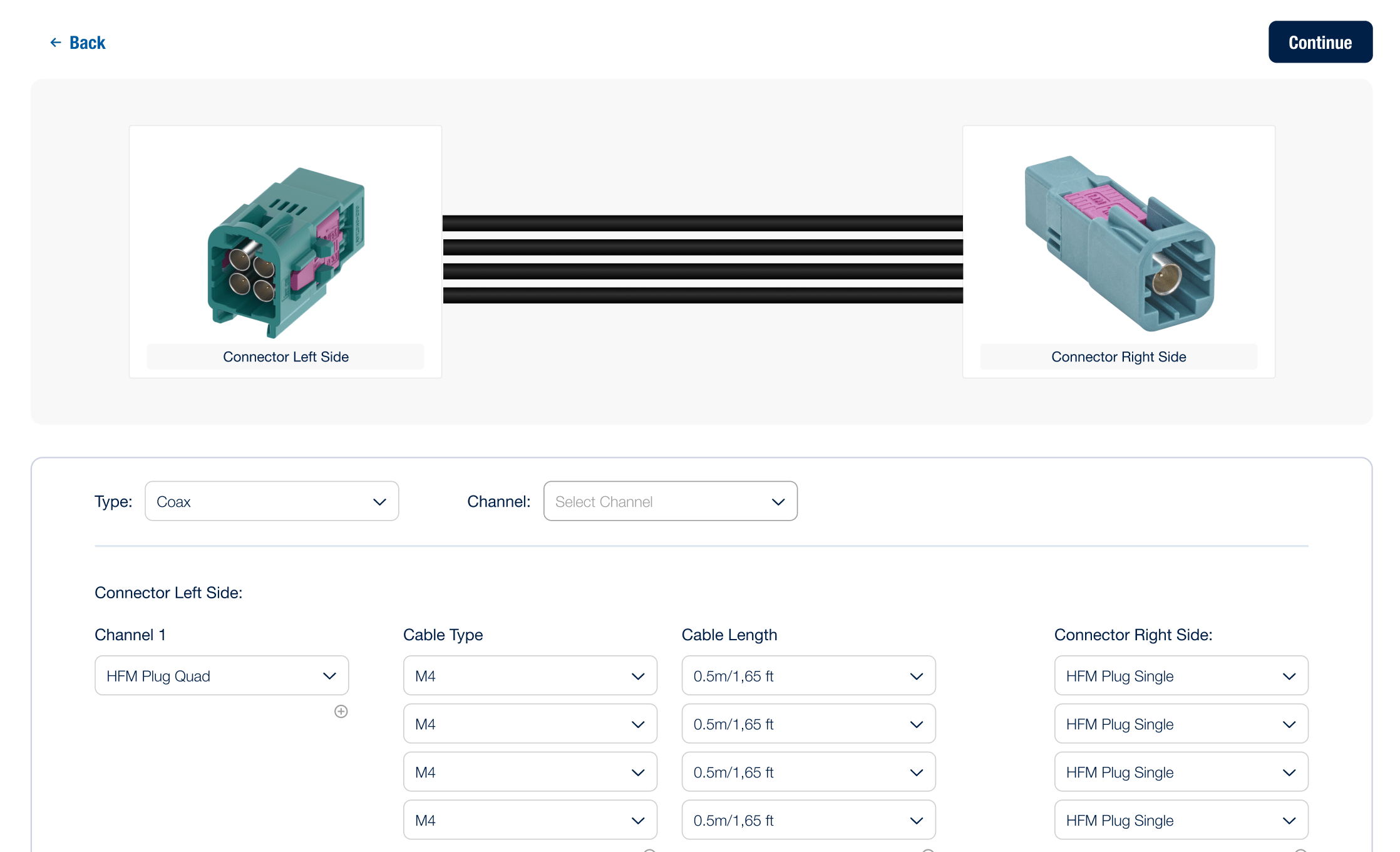
Customer A might need HFM Plug Single connector with Dacar 302-4/RTK 031 (M4) cable type, 3m/9.84ft cable length, and a HFM Jack Single right side connector:
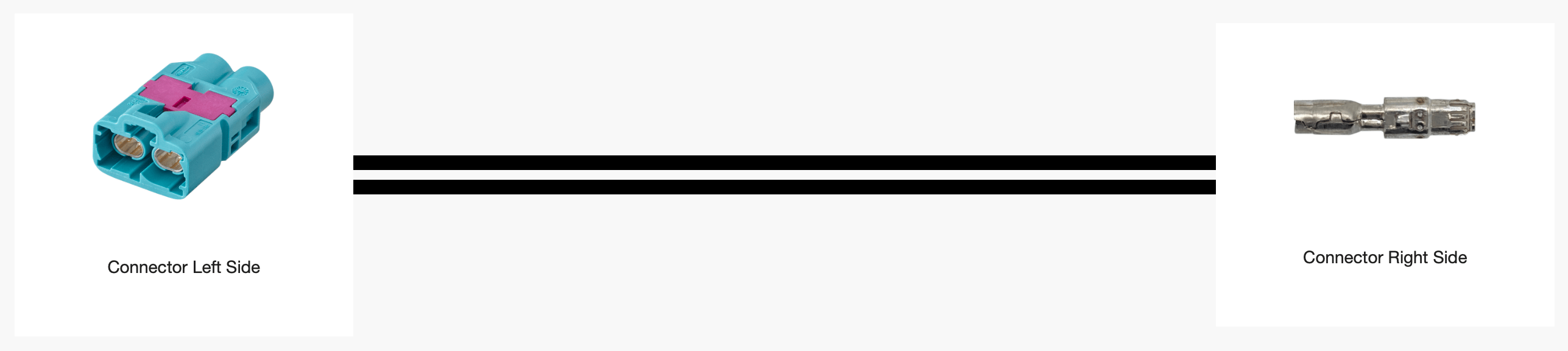
Customer B might need HFM Plug Single connector with Dacar 302-4/RTK 031 (M4) cable type, 2m/6.56ft cable length, and a H-MTD Jack Terminal right side connector:

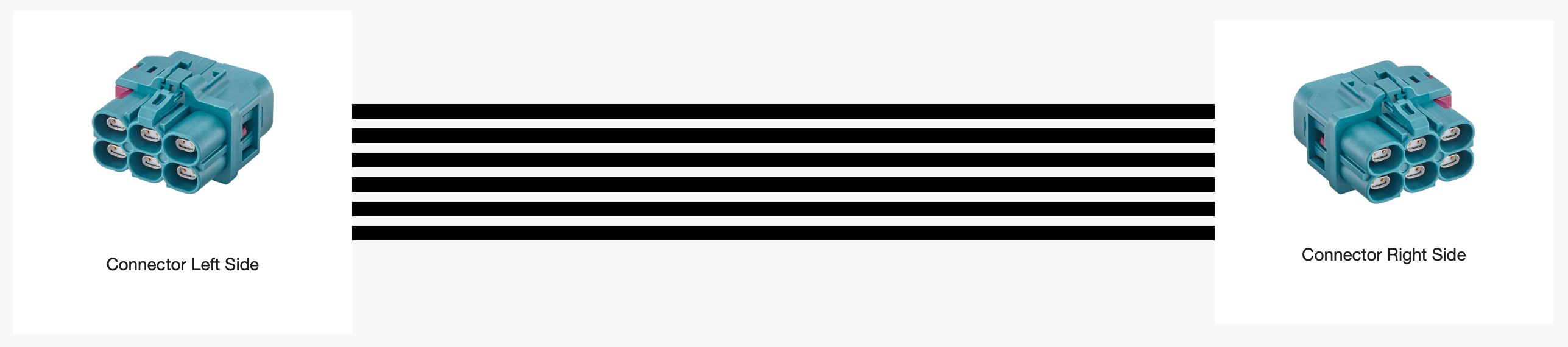
Customer N might need H-MTD Jack Hex connector with GG 2Speed 251 (CA) cable type, 1m/3.28ft cable length, and a H-MTD Jack Hex right side connector:
The unanswered question then was:
how can we design a customer solution for configuring thousands of possible cable assemblies?

with so many automotive cable assembly variations, technical dependencies, and no
realistic way to package every option as a fixed product,
with so much heavy dependence on technical customer support and sales teams,
with customers needing a way to build the exact automotive cable assembly that
matched their requirements,
First things first - meet some of the team :)
GETTING TO WORK






Nick Parker
Sales Lead, Rosenberger Group
Daniel Füger
Lead, Project Management
Ogechi Grace Abraham
Senior (Sole) UX/UI Designer
Amina Asif
Senior Software Engineer
Adil Khan
Principal Software Engineer
Saad Sherazi
Software Engineer
The first step for me was clearly defining the different customer groups this configurator needed to serve — from automotive manufacturers and Tier-1 suppliers to industrial electronics firms and distribution partners — so the flow could be designed around how each of them actually selects and orders cable assemblies:
- DEFINING THE TARGET CUSTOMER (USER) GROUPS

Tier-1 Automotive Suppliers:
Bosch, Continental, Magna - who supply critical systems and components to vehicle manufacturers

Distribution Partners & Integrators:
Avnet, Arrow Electronics, Rutronik - who resell Rosenberger products or build custom solutions for end customers in various industries.

Automotive Manufacturers (OEMs):
BMW, Volkswagen, and Daimler - who require custom cable assemblies for use in new car models, electric vehicles, and advanced driver-assistance systems.

Industrial Electronics Firms:
Siemens, ABB - who use Rosenberger’s connectivity solutions for industrial equipment and control systems.
After identifying the target customer groups, -
- CONVERSATIONS WITH THE TARGET USER GROUPS

I wanted to generally understand how they currently approached automotive
cable selection, assembly and purchase.
I also wanted to identify the main bottlenecks they experienced — especially
where the process became unclear, time-consuming, or dependent on manual
support.
And equally as important gather general insights and across customer groups
that would need to be translated into a future solution.

Needs identified

Land on cable/product pages

Review datasheets/specs

Contact support or sales

Contact support or sales

Request quote or purchase
customer -
- has a requirement for a specific automotive cable assembly
- knows either exact technical requirements or partial needs
customer -
- visits Rosenberger website / catalog
- browses product families
- searches for suitable cable or connector types
customer -
- checks connector types, cable specs, lengths, possible combinations
- compares product pages
- downloads datasheets
customer -
- reaches out to technical support or sales teams
- requests help identifying the correct cable assembly
- asks if a certain combination is possible
customer -
- waits for recommended options / confirmation
- Receives technical clarification
- reviews suggested parts or assembly details
customer -
- moves toward quote request, distributor order, or direct purchase process
- may still need validation before ordering
- internal project requirement
- engineering team
- previous documentation
- Rosenberger website
- product pages
- online catalog
- datasheets
- datasheets
- PDFs
- technical documentation
- spec tables
- sales team
- technical support
- distributor
- email / phone calls
- internal sales discussions
- product specialists
- engineering / technical support teams
- quote request
- distributor sales channel
- internal sales team
- procurement flow
- requirements may be incomplete
- user may not know the exact Rosenberger terminology/product family
- too many cable variations
- difficult to know which products are compatible
- static product info does not match exact use case
- information is fragmented across documents.
- datasheets support reference, but not decision-making
- no easy way to validate cable combinations visually
- heavy reliance on manual support
- repeated back-and-forth
- response time delays
- support team becomes the bridge between need and product
- knowledge is locked inside internal teams
- process depends on expert availability
- customer confidence is tied to human assistance, not the platform
- purchase happens after several disconnected steps
- difficult to review the final selected assembly clearly
- risk of mistakes if requirements were misunderstood earlier
Bottlenecks
Touchpoints
Customer action
General customer insights
Customer needs fell into 2 broad groups:
- those with strong technical knowledge and
- those who needed guided help translating application needs into product specs.
Repeated back-and-forth
- Customers typically needed more than one round of clarification and validation before moving toward quote or purchase
- follow up questions, waiting time for responses added more friction in the customer journey.
Heavy reliance on support:
- 7 out of 10 customers relied heavily on sales and technical support before reaching a confident purchase decision.
Datasheets are necessary, but not enough
- Datasheets were a common reference point, but they rarely gave customers enough confidence to finalize a selection on their own
Fragmented information:
- Most customers had to move across multiple disconnected touchpoints: product pages, emails, datasheets, and support channels to piece together the right cable assembly.
Purchase happened after multiple disconnected steps
- The path from product discovery to quote or procurement was not contionous or self-guided

Equally as important was getting to hear from internal Rosenberger team members
that interfaced with customers on a regular basis: to deeply understand their
internal workflows and customer challenges related to automotive cable assemblies
and the ordering process:
- CONVERSATIONS WITH ROSENBERGER TEAMS
My team and I conducted 12 interview sessions with stakeholders across sales,
technical support, application engineering, product management, and
distribution partners.
Each interview lasted approximately 40 minutes and was conducted over a
two-week period via Microsoft Teams.

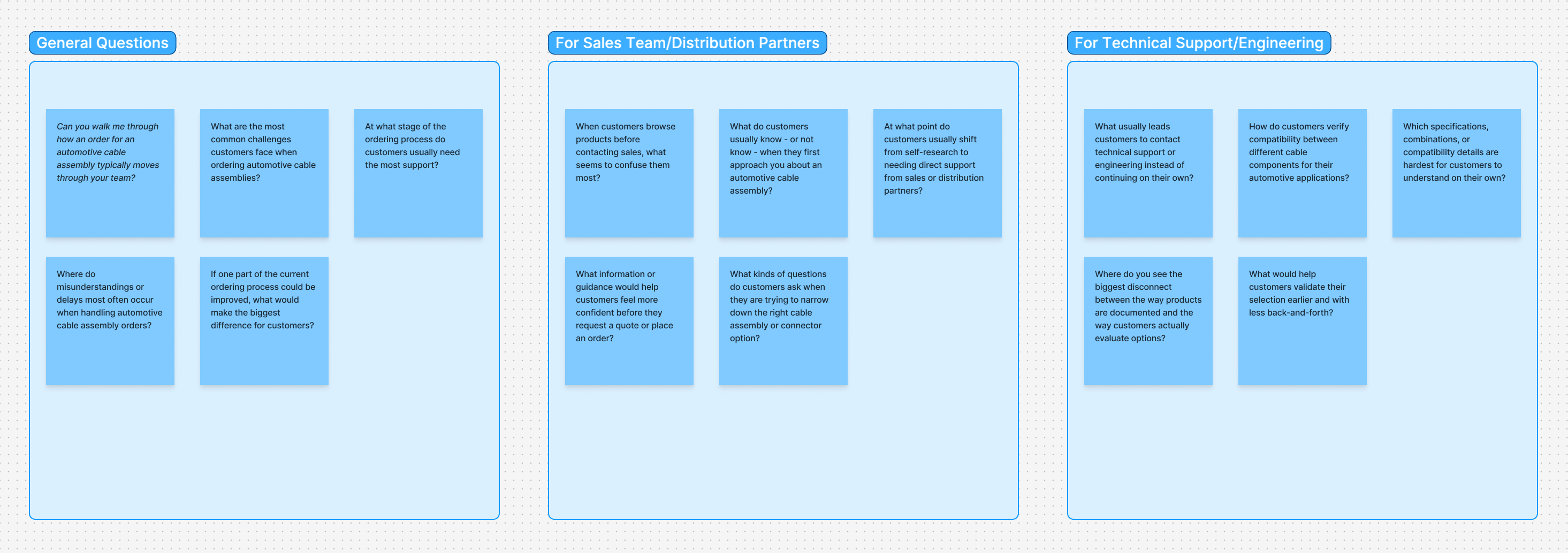
Interview questions

Summary of responses across teams
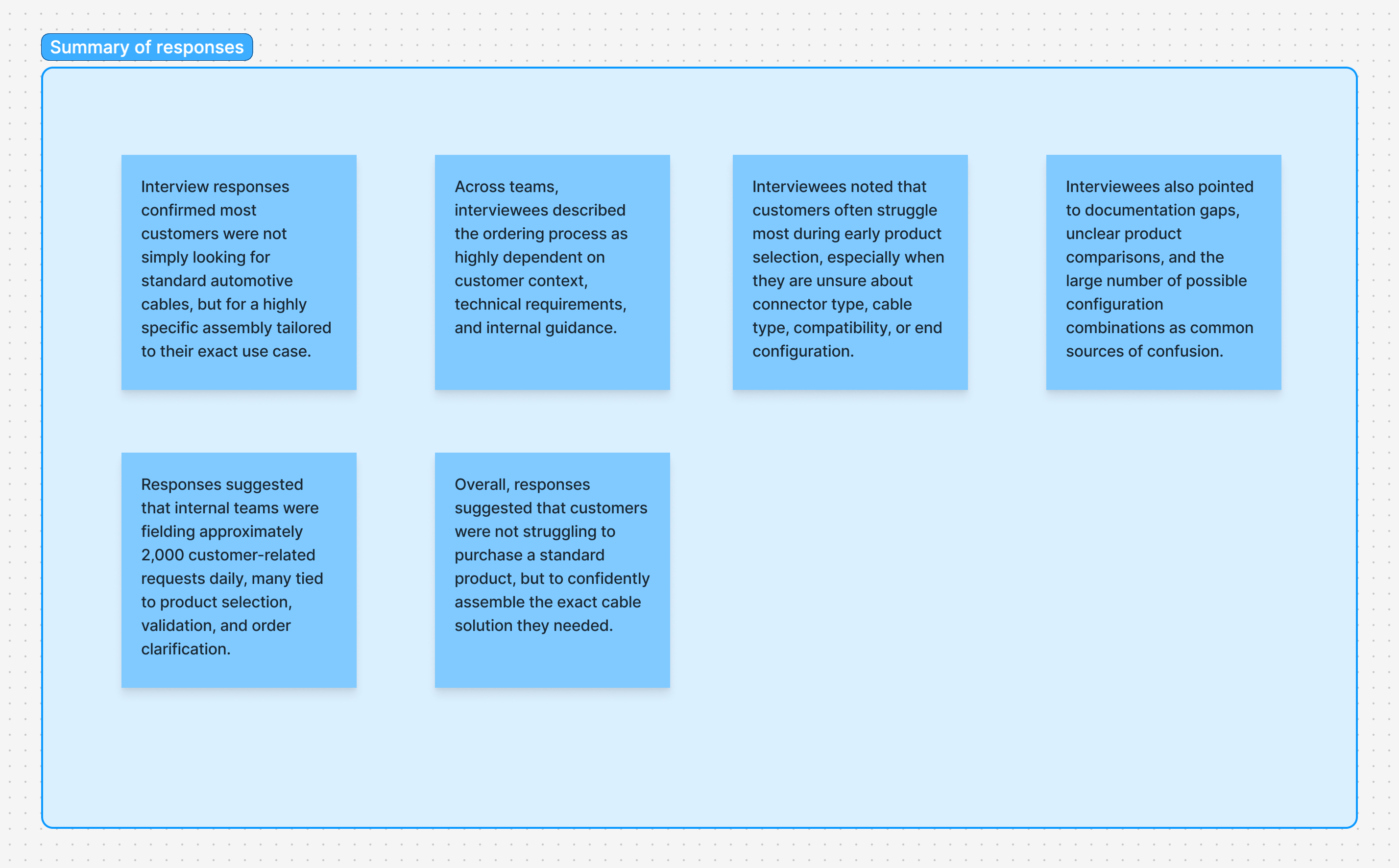
After analysing interview responses from Rosenberger customers, internal team
members, distribution partners, and several internal brainstorming sessions with my
team, it became clear what solution
to proffer:
- THE SOLUTION
let customers configure the exact cable assembly they needed themselves,
tailored to their exact use case.
simplify selection across connector types, cable types, lengths, and end
configurations
reduce reliance on support and sales teams by enabling customers to build cable
specifications independently.
- a self-service automotive cable configurator to:
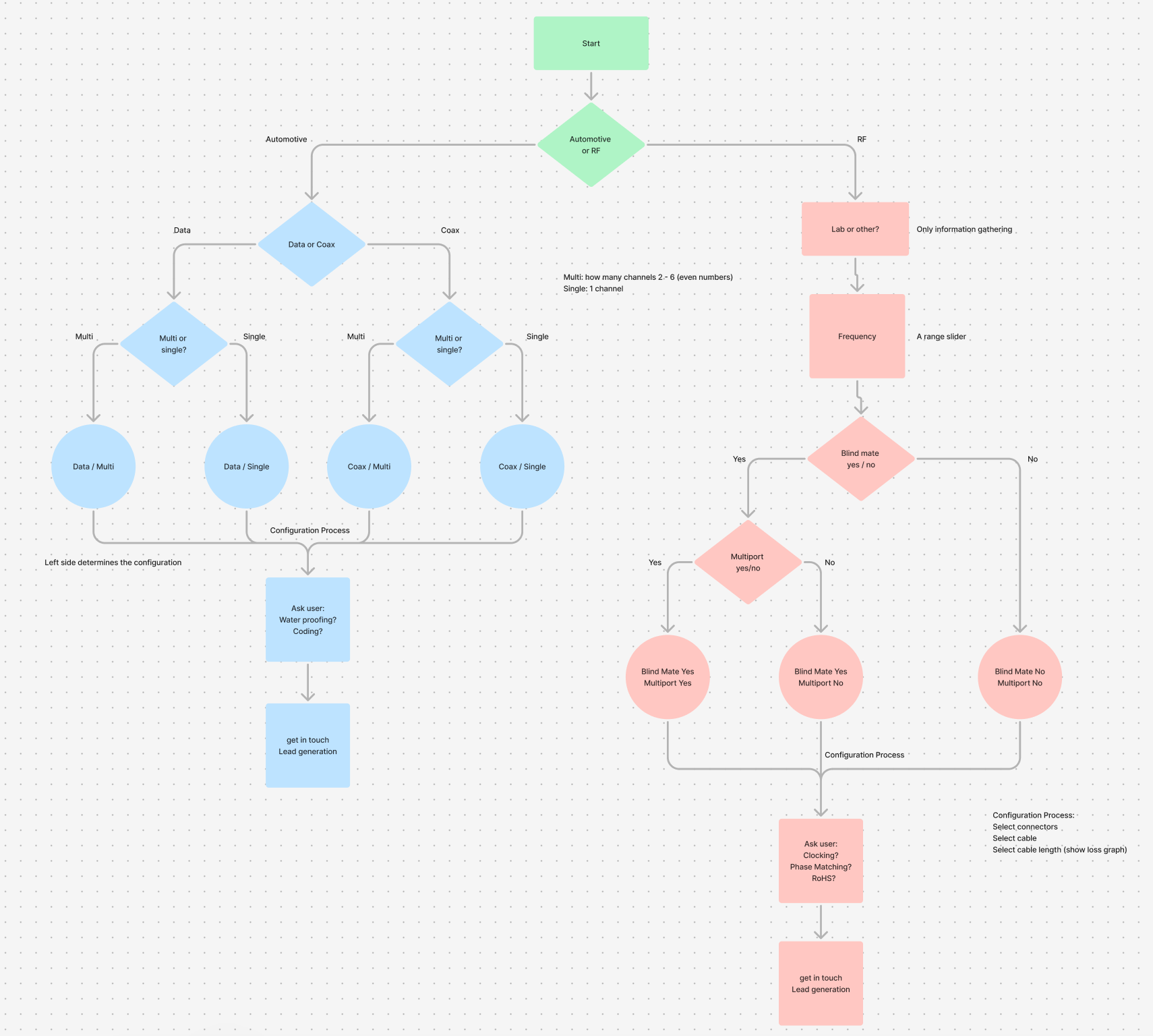
This flow maps the end-to-end logic of the self-service configurator, guiding customers through key product decisions and narrowing complex technical options into a valid cable assembly path:
- Proposed configurator flow
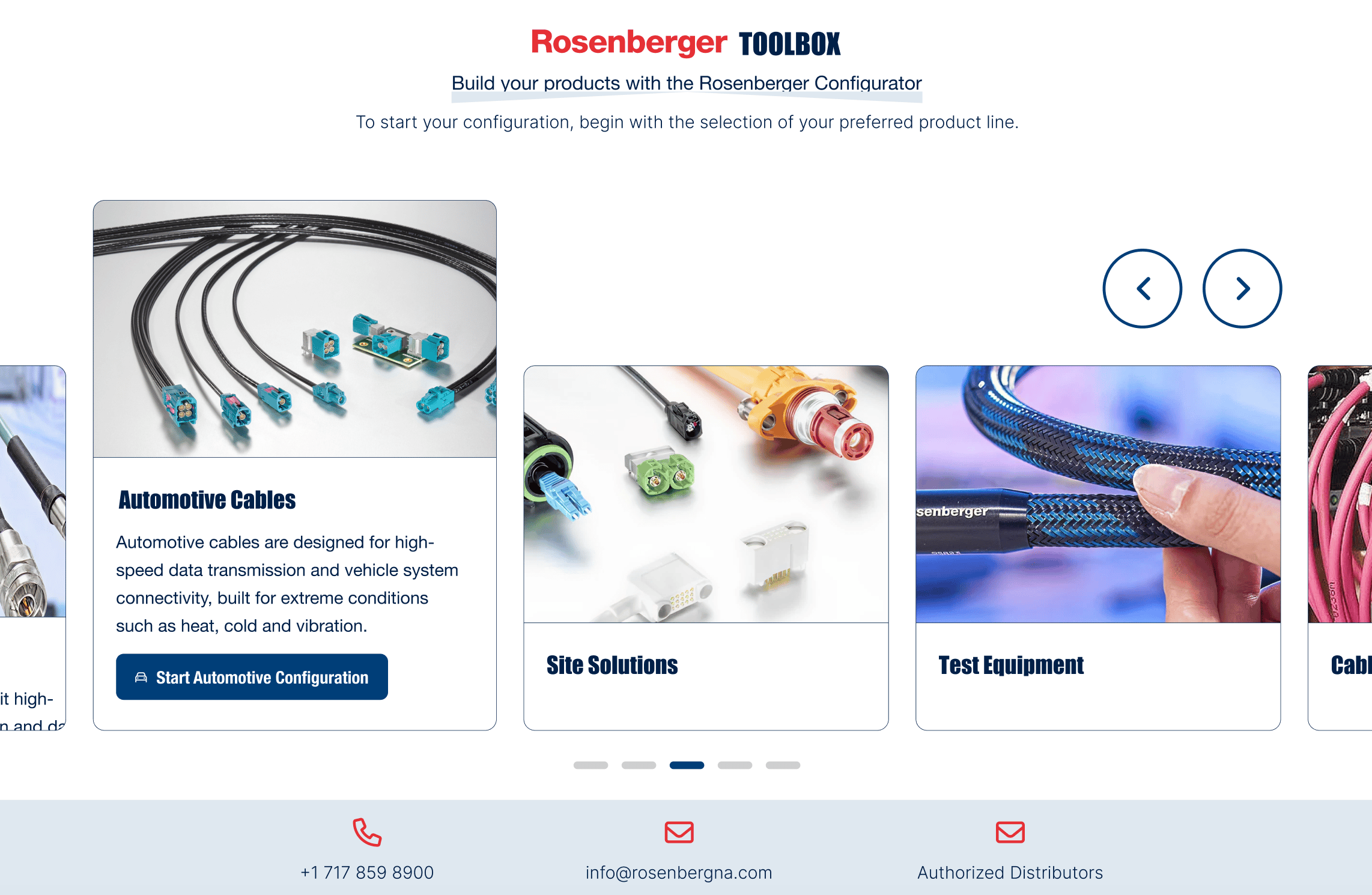
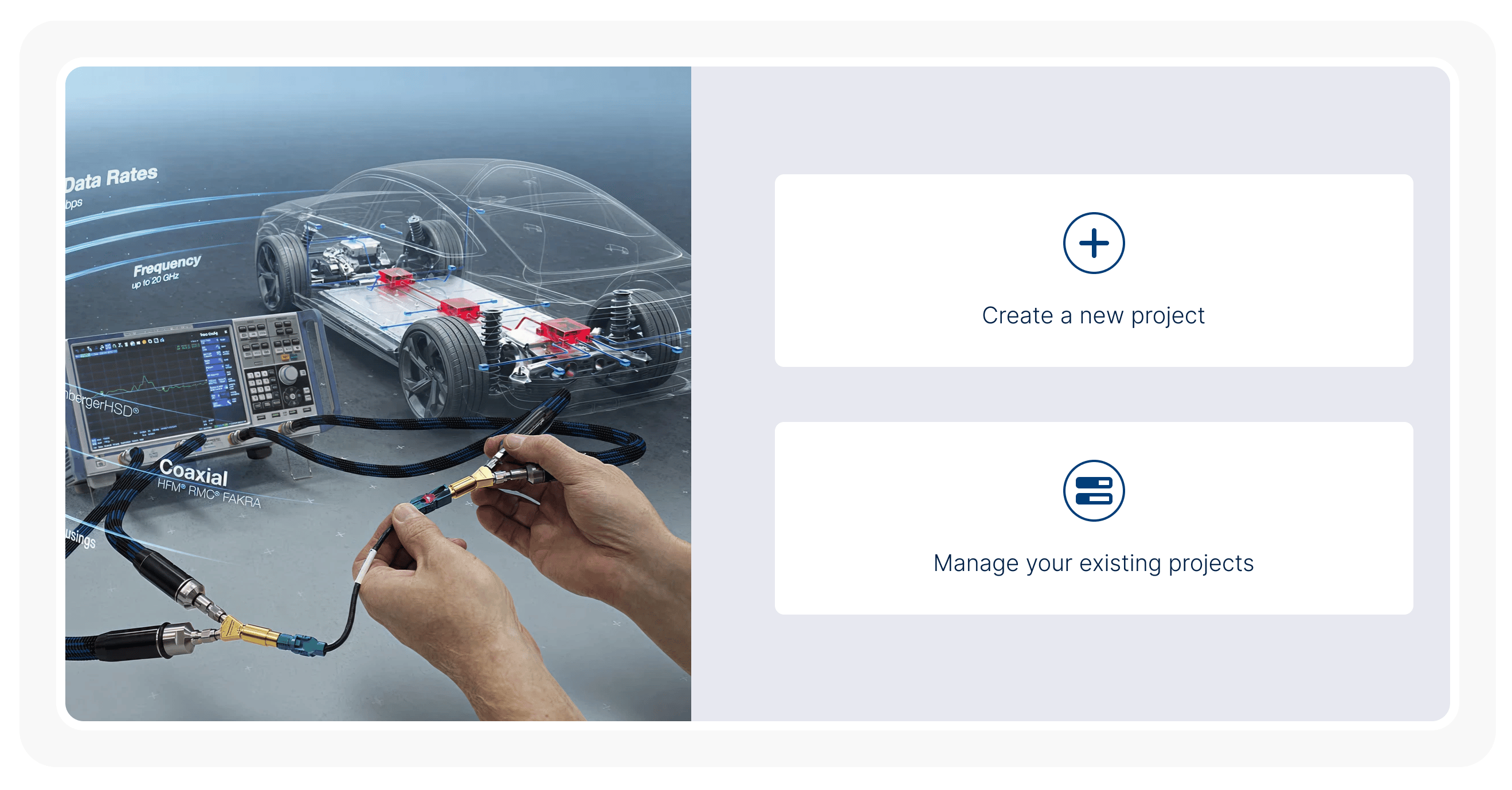
While this project focused on automotive cables and assemblies, the entry point needed to account for other product families within the Rosenberger Group, so after consultations with the Rosenberger team, we came up with the Rosenberger Toolbox concept: a shared entry point for navigating Rosenberger’s product offerings:
- Wireframes AND FINAL SCREENS
A. Entry point - automotive cable configurator:
Rosenberger -
Automotive
Cable Configurator

A bold headline
that delivers
Go ahead and say just a little more about what you do.
Call to action
Secondary
My Team and I designed and developed a self-service Automotive Cable Configurator for our Client Rosenberger Group - to help their customers configure the exact cable assembly they need, without depending on a support team or a pre-made product page for every possible variation.
1. Project Overview
Rosenberger Customers didn’t just need automotive cables.They needed cable assemblies with the right connector type, channel setup, cable type, length, and end combination for their exact use case.
That means Rosenberger couldn’t realistically create pre-made product pages for every possible combination.
- THE CHALLENGE
Picture this:
Customer A might need HFM Plug Single connector with Dacar 302-4/RTK 031 (M4) cable type, 3m/9.84ft cable length, and a HFM Jack Single right side connector:
Customer B might need HFM Plug Single connector with Dacar 302-4/RTK 031 (M4) cable type, 2m/6.56ft cable length, and a H-MTD Jack Terminal right side connector:

Customer N might need H-MTD Jack Hex connector with GG 2Speed 251 (CA) cable type, 1m/3.28ft cable length, and a H-MTD Jack Hex right side connector:
The unanswered question then was:
how can we design a customer solution for configuring thousands of possible cable assemblies?

with so many automotive cable assembly variations, technical dependencies, and no realistic way to package every option as a fixed product,
with so much heavy dependence on technical customer support and sales teams,
with customers needing a way to build the exact automotive cable assembly that matched their requirements,
First things first - meet some of the team :)
GETTING TO WORK






Nick Parker
Sales Lead, Rosenberger Group
Daniel Füger
Lead, Project Management
Ogechi Grace Abraham
Senior (Sole) UX/UI Designer
Amina Asif
Senior Software Engineer
Adil Khan
Principal Software Engineer
Saad Sherazi
Software Engineer
The first step for me was clearly defining the different customer groups this configurator needed to serve — from automotive manufacturers and Tier-1 suppliers to industrial electronics firms and distribution partners — so the flow could be designed around how each of them actually selects and orders cable assemblies:
- DEFINING THE TARGET CUSTOMER (USER) GROUPS

Automotive Manufacturers (OEMs):
BMW, Volkswagen, and Daimler - who require custom cable assemblies for use in new car models, electric vehicles, and advanced driver-assistance systems.

Tier-1 Automotive Suppliers:
Bosch, Continental, Magna - who supply critical systems and components to vehicle manufacturers

Industrial Electronics Firms:
Siemens, ABB - who use Rosenberger’s connectivity solutions for industrial equipment and control systems.

Distribution Partners & Integrators:
Avnet, Arrow Electronics, Rutronik - who resell Rosenberger products or build custom solutions for end customers in various industries.
After identifying the target customer groups, -
- CONVERSATIONS WITH THE TARGET USER GROUPS

I wanted to generally understand how they currently approached automotive cable selection, assembly and purchase.
I also wanted to identify the main bottlenecks they experienced — especially where the process became unclear, time-consuming, or dependent on manual support.
And equally as important gather general insights and across customer groups that would need to be translated into a future solution.

Needs identified

Land on cable/product pages

Review datasheets/specs

Contact support or sales

Contact support or sales

Request quote or purchase
customer -
- has a requirement for a specific automotive cable assembly
- knows either exact technical requirements or partial needs
customer -
- visits Rosenberger website / catalog
- browses product families
- searches for suitable cable or connector types
customer -
- checks connector types, cable specs, lengths, possible combinations
- compares product pages
- downloads datasheets
customer -
- reaches out to technical support or sales teams
- requests help identifying the correct cable assembly
- asks if a certain combination is possible
customer -
- waits for recommended options / confirmation
- Receives technical clarification
- reviews suggested parts or assembly details
customer -
- moves toward quote request, distributor order, or direct purchase process
- may still need validation before ordering
- internal project requirement
- engineering team
- previous documentation
- Rosenberger website
- product pages
- online catalog
- datasheets
- datasheets
- PDFs
- technical documentation
- spec tables
- sales team
- technical support
- distributor
- email / phone calls
- internal sales discussions
- product specialists
- engineering / technical support teams
- quote request
- distributor sales channel
- internal sales team
- procurement flow
- requirements may be incomplete
- user may not know the exact Rosenberger terminology/product family
- too many cable variations
- difficult to know which products are compatible
- static product info does not match exact use case
- information is fragmented across documents.
- datasheets support reference, but not decision-making
- no easy way to validate cable combinations visually
- heavy reliance on manual support
- repeated back-and-forth
- response time delays
- support team becomes the bridge between need and product
- knowledge is locked inside internal teams
- process depends on expert availability
- customer confidence is tied to human assistance, not the platform
- purchase happens after several disconnected steps
- difficult to review the final selected assembly clearly
- risk of mistakes if requirements were misunderstood earlier
Bottlenecks
Touchpoints
Customer action
General customer insights
Customer needs fell into 2 broad groups:
- those with strong technical knowledge and
- those who needed guided help translating application needs into product specs.
Repeated back-and-forth
- Customers typically needed more than one round of clarification and validation before moving toward quote or purchase
- follow up questions, waiting time for responses added more friction in the customer journey.
Heavy reliance on support:
- 7 out of 10 customers relied heavily on sales and technical support before reaching a confident purchase decision.
Datasheets are necessary, but not enough
- Datasheets were a common reference point, but they rarely gave customers enough confidence to finalize a selection on their own
Fragmented information:
- Most customers had to move across multiple disconnected touchpoints: product pages, emails, datasheets, and support channels to piece together the right cable assembly.
Purchase happened after multiple disconnected steps
- The path from product discovery to quote or procurement was not contionous or self-guided

Equally as important was getting to hear from internal Rosenberger team members that interfaced with customers on a regular basis: to deeply understand their internal workflows and customer challenges related to automotive cable assemblies and the ordering process:
- CONVERSATIONS WITH INTERNAL ROSENBERGER TEAMS
My team and I conducted 12 interview sessions with stakeholders across sales, technical support, application engineering, product management, and distribution partners.
Each interview lasted approximately 40 minutes and was conducted over a two-week period via Microsoft Teams.

Interview questions

Summary of responses across teams
After analysing interview responses from Rosenberger customers, internal team members, distribution partners, and several internal brainstorming sessions with my team, it became clear what solution
to proffer:
- THE SOLUTION
let customers configure the exact cable assembly they needed themselves, tailored to their exact use case.
simplify selection across connector types, cable types, lengths, and end configurations
reduce reliance on support and sales teams by enabling customers to build cable specifications independently.
- a self-service automotive cable configurator to:
This flow maps the end-to-end logic of the self-service configurator, guiding customers through key product decisions and narrowing complex technical options into a valid cable assembly path:
- Proposed configurator flow
While this project focused on automotive cables and assemblies, the entry point needed to account for other product families within the Rosenberger Group, so after consultations with the Rosenberger team, we came up with the Rosenberger Toolbox concept: a shared entry point for navigating Rosenberger’s product offerings:
- Wireframes AND FINAL SCREENS
A. Entry point - automotive cable configurator:
Rosenberger - Automotive Cable Configurator
A bold headline
that delivers
Go ahead and say just a little more about what you do.
Call to action
Secondary
My Team and I designed and developed a self-service Automotive Cable Configurator for our Client Rosenberger Group - to help their customers configure the exact cable assembly they need, without depending on a support team or a pre-made product page for every possible variation.
1. Project Overview
Rosenberger Customers didn’t just need automotive cables.They needed cable assemblies with the right connector type, channel setup, cable type, length, and end combination for their exact use case.
That means Rosenberger couldn’t realistically create pre-made product pages for every possible combination.
- THE CHALLENGE
Picture this:
Customer A might need HFM Plug Single connector with Dacar 302-4/RTK 031 (M4) cable type, 3m/9.84ft cable length, and a HFM Jack Single right side connector:
Customer B might need HFM Plug Single connector with Dacar 302-4/RTK 031 (M4) cable type, 2m/6.56ft cable length, and a H-MTD Jack Terminal right side connector:

Customer N might need H-MTD Jack Hex connector with GG 2Speed 251 (CA) cable type, 1m/3.28ft cable length, and a H-MTD Jack Hex right side connector:
The unanswered question then was:
how can we design a customer solution for configuring thousands of possible cable assemblies?

with so many automotive cable assembly variations, technical dependencies, and no realistic way to package every option as a fixed product,
with so much heavy dependence on technical customer support and sales teams,
with customers needing a way to build the exact automotive cable assembly that matched their requirements,
First things first - meet some of the team :)
GETTING TO WORK






Nick Parker
Sales Lead, Rosenberger Group
Daniel Füger
Lead, Project Management
Ogechi Grace Abraham
Senior (Sole) UX/UI Designer
Amina Asif
Senior Software Engineer
Adil Khan
Principal Software Engineer
Saad Sherazi
Software Engineer
The first step for me was clearly defining the different customer groups this configurator needed to serve — from automotive manufacturers and Tier-1 suppliers to industrial electronics firms and distribution partners — so the flow could be designed around how each of them actually selects and orders cable assemblies:
- DEFINING THE TARGET CUSTOMER (USER) GROUPS

Automotive Manufacturers (OEMs):
BMW, Volkswagen, and Daimler - who require custom cable assemblies for use in new car models, electric vehicles, and advanced driver-assistance systems.

Tier-1 Automotive Suppliers:
Bosch, Continental, Magna - who supply critical systems and components to vehicle manufacturers

Industrial Electronics Firms:
Siemens, ABB - who use Rosenberger’s connectivity solutions for industrial equipment and control systems.

Distribution Partners & Integrators:
Avnet, Arrow Electronics, Rutronik - who resell Rosenberger products or build custom solutions for end customers in various industries.
After identifying the target customer groups, -
- CONVERSATIONS WITH THE TARGET USER GROUPS
I wanted to generally understand how they currently approached automotive cable selection, assembly and purchase.
I also wanted to identify the main bottlenecks they experienced — especially where the process became unclear, time-consuming, or dependent on manual support.
And equally as important gather general insights and across customer groups that would need to be translated into a future solution.

Needs identified
Land on cable/product pages
Review datasheets/specs
Contact support or sales
Contact support or sales

Request quote or purchase
customer -
- has a requirement for a specific automotive cable assembly
- knows either exact technical requirements or partial needs
customer -
- visits Rosenberger website / catalog
- browses product families
- searches for suitable cable or connector types
customer -
- checks connector types, cable specs, lengths, possible combinations
- compares product pages
- downloads datasheets
customer -
- reaches out to technical support or sales teams
- requests help identifying the correct cable assembly
- asks if a certain combination is possible
customer -
- waits for recommended options / confirmation
- Receives technical clarification
- reviews suggested parts or assembly details
customer -
- moves toward quote request, distributor order, or direct purchase process
- may still need validation before ordering
- internal project requirement
- engineering team
- previous documentation
- Rosenberger website
- product pages
- online catalog
- datasheets
- datasheets
- PDFs
- technical documentation
- spec tables
- sales team
- technical support
- distributor
- email / phone calls
- internal sales discussions
- product specialists
- engineering / technical support teams
- quote request
- distributor sales channel
- internal sales team
- procurement flow
- requirements may be incomplete
- user may not know the exact Rosenberger terminology/product family
- too many cable variations
- difficult to know which products are compatible
- static product info does not match exact use case
- information is fragmented across documents.
- datasheets support reference, but not decision-making
- no easy way to validate cable combinations visually
- heavy reliance on manual support
- repeated back-and-forth
- response time delays
- support team becomes the bridge between need and product
- knowledge is locked inside internal teams
- process depends on expert availability
- customer confidence is tied to human assistance, not the platform
- purchase happens after several disconnected steps
- difficult to review the final selected assembly clearly
- risk of mistakes if requirements were misunderstood earlier
Bottlenecks
Touchpoints
Customer action
General customer insights
Customer needs fell into 2 broad groups:
- those with strong technical knowledge and
- those who needed guided help translating application needs into product specs.
Repeated back-and-forth
- Customers typically needed more than one round of clarification and validation before moving toward quote or purchase
- follow up questions, waiting time for responses added more friction in the customer journey.
Heavy reliance on support:
- 7 out of 10 customers relied heavily on sales and technical support before reaching a confident purchase decision.
Datasheets are necessary, but not enough
- Datasheets were a common reference point, but they rarely gave customers enough confidence to finalize a selection on their own
Fragmented information:
- Most customers had to move across multiple disconnected touchpoints: product pages, emails, datasheets, and support channels to piece together the right cable assembly.
Purchase happened after multiple disconnected steps
- The path from product discovery to quote or procurement was not contionous or self-guided

Equally as important was getting to hear from internal Rosenberger team members that interfaced with customers on a regular basis: to deeply understand their internal workflows and customer challenges related to automotive cable assemblies and the ordering process:
- CONVERSATIONS WITH INTERNAL ROSENBERGER TEAMS
My team and I conducted 12 interview sessions with stakeholders across sales, technical support, application engineering, product management, and distribution partners.
Each interview lasted approximately 40 minutes and was conducted over a two-week period via Microsoft Teams.
Interview questions
Summary of responses across teams
After analysing interview responses from Rosenberger customers, internal team members, distribution partners, and several internal brainstorming sessions with my team, it became clear what solution
to proffer:
- THE SOLUTION
let customers configure the exact cable assembly they needed themselves, tailored to their exact use case.
simplify selection across connector types, cable types, lengths, and end configurations
reduce reliance on support and sales teams by enabling customers to build cable specifications independently.
- a self-service automotive cable configurator to:
This flow maps the end-to-end logic of the self-service configurator, guiding customers through key product decisions and narrowing complex technical options into a valid cable assembly path:
- Proposed configurator flow
While this project focused on automotive cables and assemblies, the entry point needed to account for other product families within the Rosenberger Group, so after consultations with the Rosenberger team, we came up with the Rosenberger Toolbox concept: a shared entry point for navigating Rosenberger’s product offerings:
- Wireframes AND FINAL SCREENS
A. Entry point - automotive cable configurator:
Rosenberger - Automotive Cable Configurator